


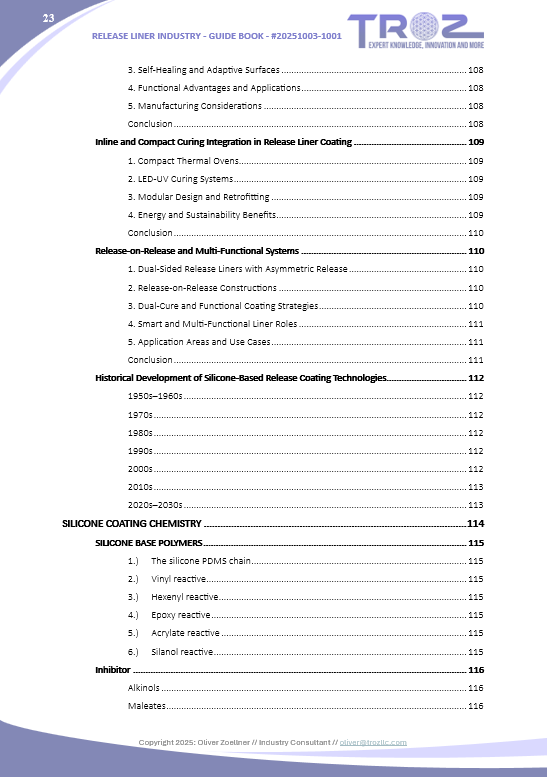
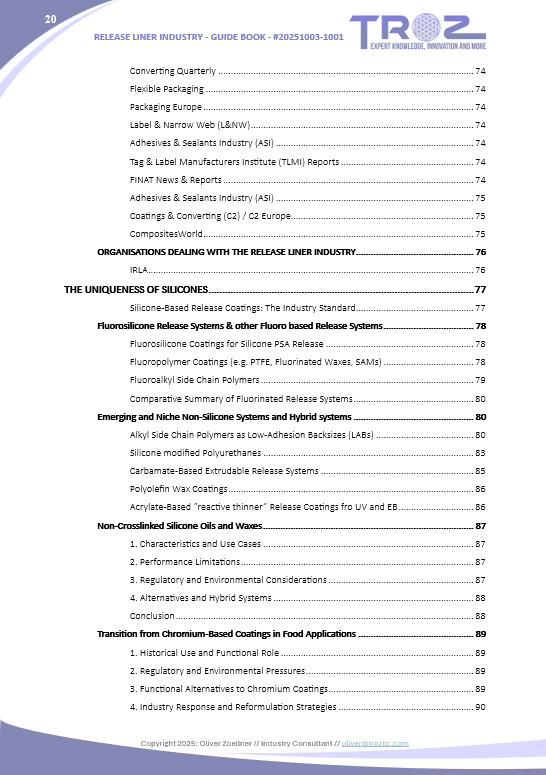
The narrative begins with first principles—what a release liner is, why it matters, and how structure (substrates, primers, silicone systems) governs performance across the adhesive lifecycle—then tracks the industry’s evolution from waxed papers to solventless and UV/EB systems, digitally instrumented coating lines, and multilayer engineered surfaces. A systems perspective links silicone chemistry (base polymers, cure profiles, inhibitors, controlled release design, multilayer architectures) to process realities (gravure, micro-gravure, slot-die, curtain, multilayer slides; oven design and synchronization; inline mixing and dosing; surface activation; static control; machine vision; coat-weight and moisture control), showing how formulation choices translate into stability, speed, yield, and cost. Adhesion science is treated as both physics and practice—peel dynamics, subsequent adhesion, transfer resistance, curl—and the diagnostics and quality chapters convert methods into decisions that hold up under production pressure. A substantial troubleshooting section provides pattern recognition, root-cause trees, and case methods that can be applied on a live line.
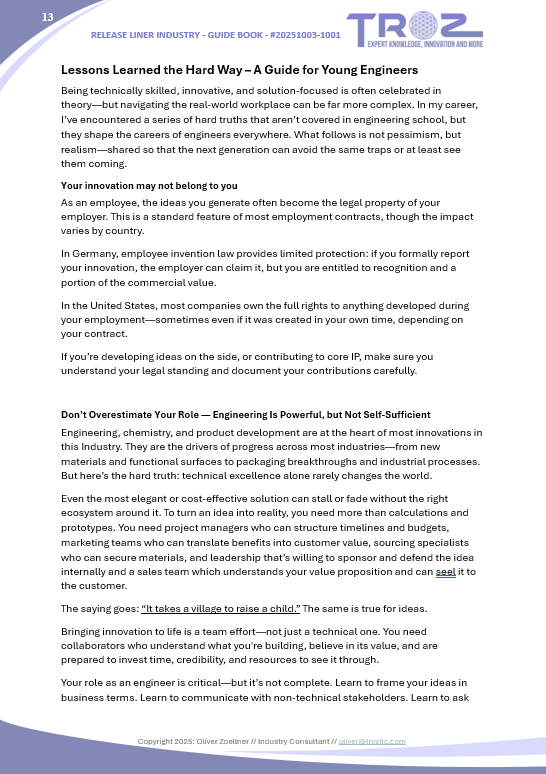
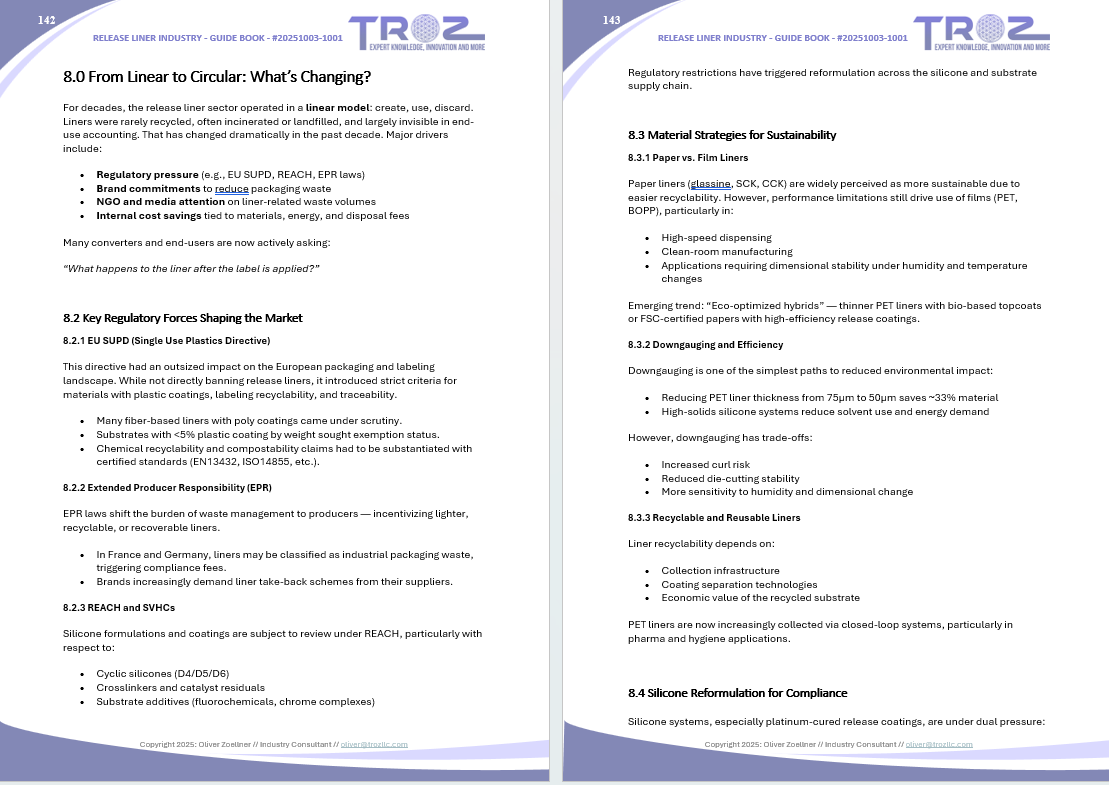
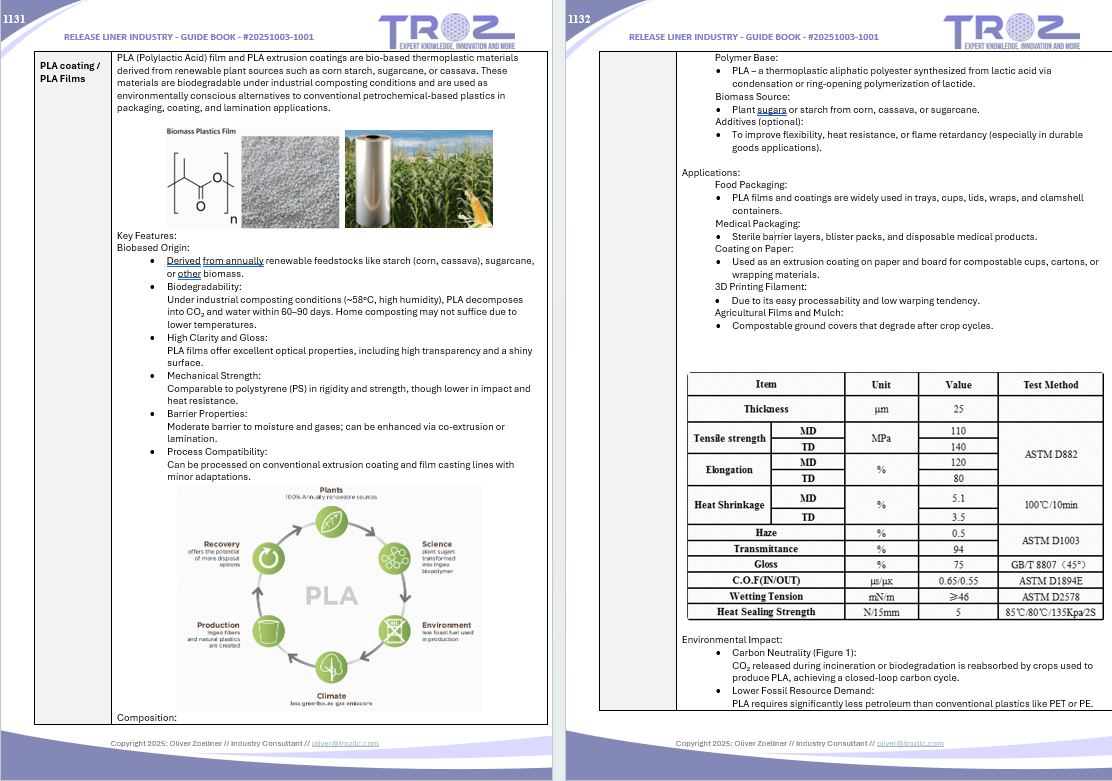
Broader chapters cover substrate engineering (SCK, glassine, CCK, PCK; PET, PP, HDPE, co-extrusions), sustainability and circularity (de-siliconization, closed-loop PET reuse, low-energy curing, bio-based pathways), and market structure with regional outlooks and trade-flow implications—connecting technology to sourcing, competitiveness, and risk. Innovation & value creation offers a practical playbook for moving from problem to prototype, avoiding “me-too” traps, and capturing margin with differentiated performance; the private-equity pitfalls framework distills hard lessons on capex governance, pricing discipline, technology readiness, and talent—so strategy aligns with operational truth.
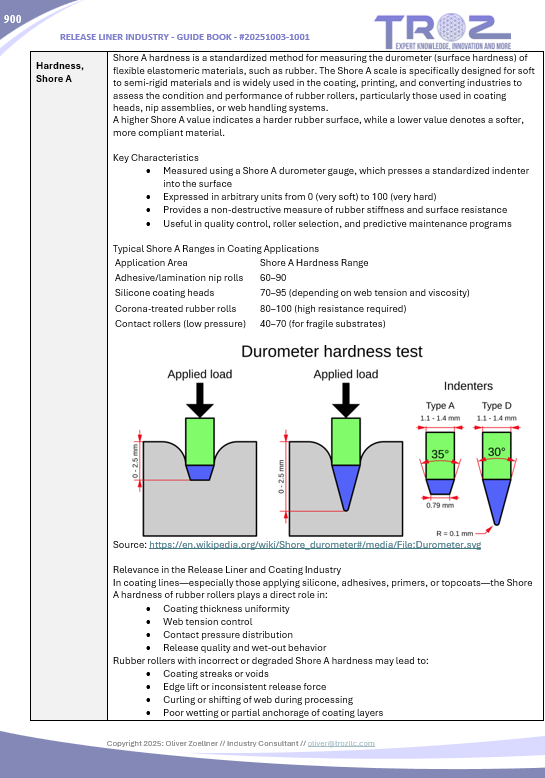
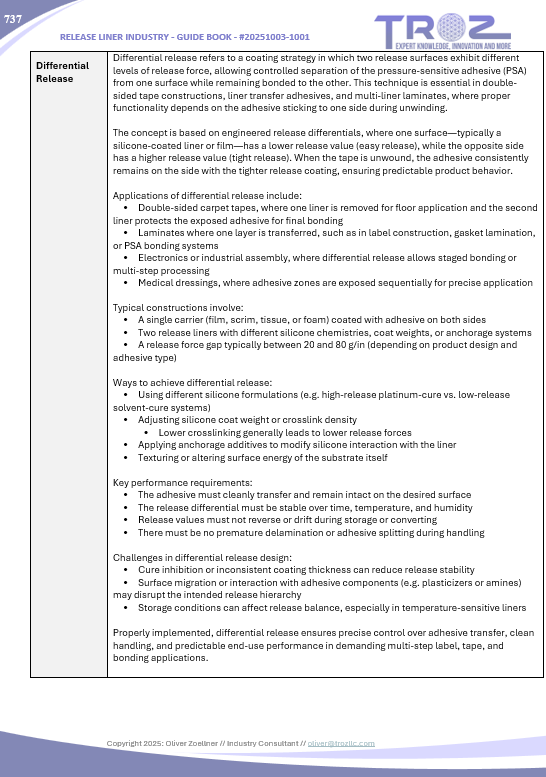
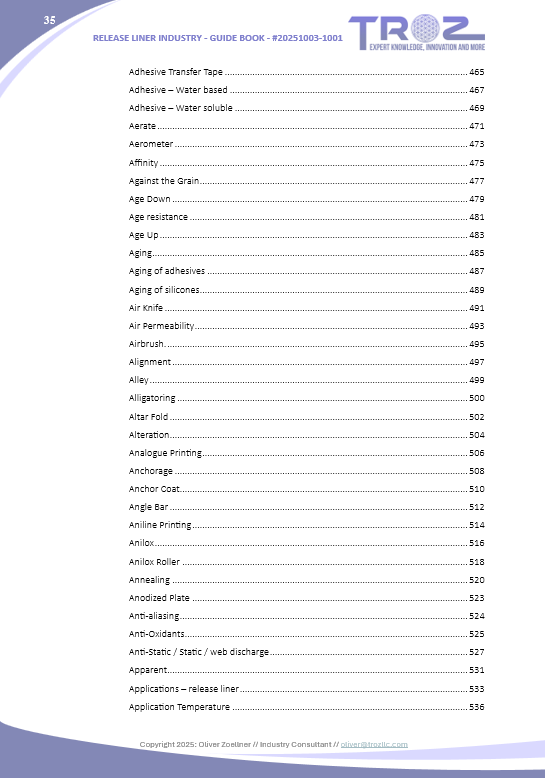
The reference backbone is a 600-page, deeply annotated glossary—not a list of definitions, but mini-chapters that unpack mechanisms, standards, and failure modes. Entries such as Blanket Cylinder (offset printing mechanics, construction, and DIN context), Bleeding (migration mechanisms, barriers, compatibility), and Blocking (silicone cure interactions, set-off differentiation, prevention strategies) model the level of detail, linking terminology directly to design and troubleshooting practice.
Designed for engineers, developers, operations leaders, procurement, investors, and boards, the Guidebook bridges the gap between the production floor and the boardroom—explaining not only what to do, but why it works and where it moves the business. And beyond these highlights, the book touches on many more topics across chemistry, converting, applications, quality, and strategy—so it remains useful on day one and indispensable over time.